Sugarcane has two make-or-break water windows — establishment and jointing. A practical guide to using potassium polyacrylate SAP to hold moisture and cut fertiliser leaching across a full ratoon cycle.
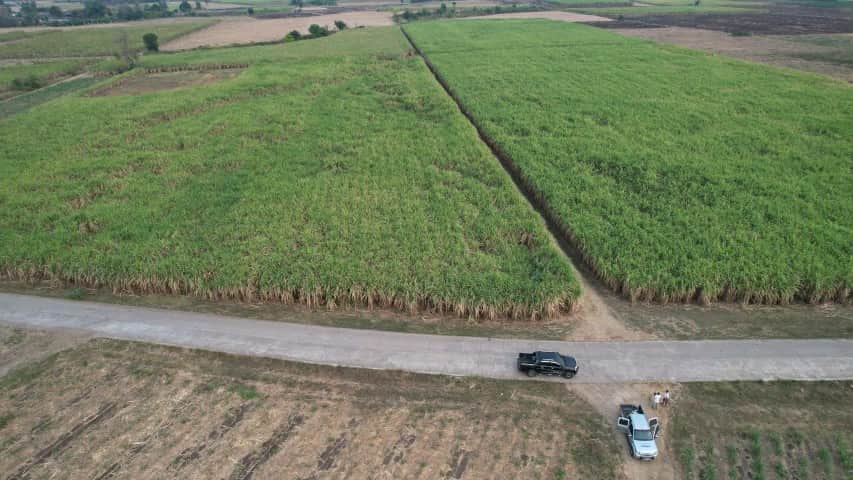
Sugarcane is one of the thirstiest field crops. A full plant crop cycle runs 10–18 months depending on variety and region, and total water demand over that period is high. But the crop does not need water evenly across its life — there are two phases where inadequate moisture does disproportionate damage:
Establishment (0–90 days after planting). Sett germination and early root development depend on consistent soil moisture. A dry spell here delays canopy closure, lets weeds compete, and sets a lower ceiling on final stalk count. In most of Thailand's sugarcane belt, this phase overlaps with the early wet season — but dry spells between rains are common, and new plantings on sandy or well-drained soils can dry out fast.
Jointing (grand growth phase). Once the sugarcane enters rapid stalk elongation — roughly from month 3–4 through to the late season — it demands a steady moisture supply. Stress during jointing reduces internode length and stalk weight directly. This is where yield potential gets locked in or lost.
Between these two peaks, the crop is more tolerant. But with a season that runs longer than a year, a soil that holds moisture more efficiently saves irrigation cost and management effort across every dry spell.
Potassium polyacrylate (K-PA) is a cross-linked polymer that absorbs water — up to 300–400 times its own weight — and holds it in a gel matrix. When the surrounding soil dries out, osmotic pressure causes the gel to slowly release moisture back into the root zone.
The potassium version (K-PA rather than sodium polyacrylate) is preferred for agricultural use because the polymer releases K⁺ ions as it ages, contributing a slow-release potassium source to the soil. It does not accumulate salts the way sodium-based alternatives can.
In the soil, K-PA lasts approximately 2–3 years before it breaks down into CO₂, NH₃, and water — products that are harmless and absorbed by the crop. For a ratoon crop like sugarcane, this lifespan covers one full plant-plus-ratoon cycle, which makes the per-season economics more attractive than for annual crops.
SAP for sugarcane is not broadcast on the surface. It must be incorporated into the soil at root depth to function. The standard method:
The goal is to get the SAP into the active root zone — typically the top 15–20 cm of soil — where it will absorb irrigation water and rainfall and hold it accessible to roots through dry intervals.
Rate guidance:
This is underappreciated for sugarcane. Most fertiliser loss happens during heavy rains — particularly in the wet-season months that align with the establishment and jointing phases. Over an 18-month cycle, repeated leaching events can move a significant fraction of your basal and top-dress fertiliser out of the root zone before the crop can use it.
K-PA holds nutrient ions — including NH₄⁺, K⁺, and some phosphates — in the gel matrix alongside water. As moisture is released to the roots, nutrients follow. This mechanism reduces fertiliser leaching by approximately 15–30% in field conditions.
For a sugarcane grower applying substantial fertiliser input across a long season, this retention benefit is worth factoring into the cost-benefit calculation — not as a replacement for good fertiliser management, but as a buffer that makes each application more efficient.
If you have applied SAP at planting and the first rains are erratic, here is what a working application looks like:
If emergence is patchy despite the application, check that the SAP was actually incorporated at depth and not left close to the surface. Gel near the surface dries out rather than absorbing water from rainfall.
SAP extends the time your soil holds moisture. It does not substitute for water that is not there. In a genuine drought year with no irrigation backup, SAP buys extra days — it does not replace a dry-season irrigation system.
It also does not improve soil structure on its own. Compacted or degraded soils benefit from organic matter addition or subsoil tillage before planting. SAP is most effective in reasonably prepared soil where the root zone is accessible.
Sugarcane is commonly harvested two to four times from the same root system before replanting. Over a two-to-three ratoon cycle:
This makes the lifetime cost per hectare lower than it appears when looking at the per-kg price alone.
If you grow sugarcane and want specific rate recommendations for your soil type and irrigation setup, get in touch. We can advise on application method, quantities, and supply.
Published by Green Regeneration 1954 Co., Ltd.
Have questions about SAP, or ready to place an order? Get in touch.
Contact us